





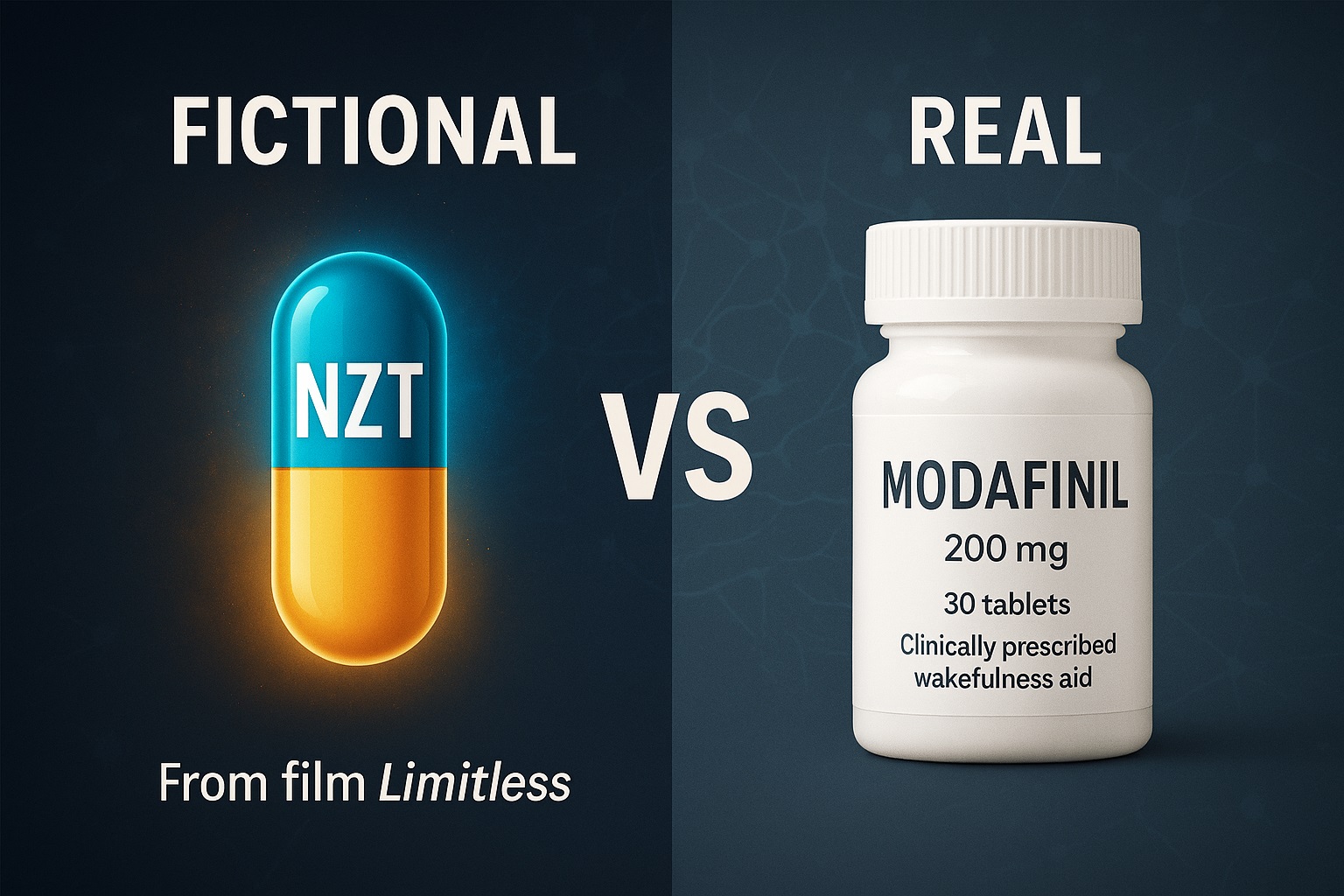
Ever caught yourself daydreaming about a pill that could unlock hidden reservoirs of focus, creativity, and intelligence, much like the enigmatic NZT-48 from the movie Limitless? It’s a tantalizing fantasy—one that turns an ordinary person into a superhuman thinker overnight. I’ve heard this yearning echoed in countless conversations with clients, from overworked professionals to students pushing their mental boundaries. But in the real world, where science meets ethics, no such miracle exists. Instead, we have a spectrum of cognitive enhancers—some legal, some experimental—that offer glimpses of enhanced performance. In this exploration, we’ll sift through various medications and supplements, weighing their merits and drawbacks, before landing on modafinil as the closest thing NZT-48’s fictional prowess.
The allure of cognitive enhancement isn’t new. From ancient herbal remedies to modern pharmaceuticals, humans have long sought ways to sharpen the mind. Yet, the Limitless narrative amplifies this desire, portraying NZT-48 as a drug that erases mental fog, boosts memory, and fuels relentless productivity without apparent downsides. In reality, every enhancer comes with trade-offs—side effects, legal hurdles, or limited efficacy. Drawing from our collaborations with neuroscientists and client feedback, we’ve seen how the pursuit of “brain boosts” can lead to remarkable gains but also unexpected pitfalls. Let’s start by dissecting what NZT-48 represents, then venture into real-world alternatives, building toward why modafinil stands apart.
Demystifying NZT-48: Fiction’s Perfect Pill and Its Real-World Echoes
What if a single dose could transform your brain into a high-performance machine, processing information at lightning speed and retaining it flawlessly? That’s the promise of NZT-48 in Limitless—a fictional nootropic that enhances executive function, memory, and motivation while eliminating fatigue. Created for cinematic drama, it draws from concepts in neuroscience, like neuroplasticity and neurotransmitter modulation, but exaggerates them beyond current capabilities. In the story, protagonist Eddie Morra experiences euphoric clarity, solving complex problems effortlessly, but faces addiction and blackouts as the plot twists.
From our perspective at NeuroPeak, where we’ve analyzed hundreds of cognitive enhancement protocols, NZT-48 symbolizes the ultimate “smart drug”: one that amplifies dopamine for motivation, norepinephrine for focus, and perhaps acetylcholine for learning—all without crashing. Real drugs target these pathways selectively, but none combine them perfectly. For instance, stimulants ramp up dopamine but risk overstimulation. This gap fuels the search for approximations, blending excitement with realism. Clients often ask, “Is there anything close?” Our answer: Yes, but with caveats. We’ll explore stimulants first, as they mimic NZT’s energy surge, before moving to subtler options.
The movie’s portrayal isn’t entirely baseless. It nods to real nootropics—substances that support brain health—and psychostimulants used for conditions like ADHD or narcolepsy. But fiction omits the science: True enhancement requires safety, sustainability, and ethical use. As we delve into candidates, keep in mind studies showing that while some drugs improve specific tasks, broad “genius-level” boosts remain elusive. A 2024 review on PubMed, for example, highlights how cognitive enhancers excel in fatigued states but offer marginal gains in healthy individuals This sets the stage for our journey through real contenders.
Stimulants: The High-Octane Boosters That Echo NZT’s Intensity
Imagine a drug that floods your brain with energy, sharpening attention and banishing drowsiness—sounds like NZT-48’s kickstart, right? Stimulants like amphetamines come closest in raw power, mimicking the movie’s immediate “on-switch” effect. These compounds, often prescribed for ADHD or narcolepsy, increase dopamine and norepinephrine, heightening alertness and motivation. At NeuroPeak, we’ve counseled clients who turn to them for demanding jobs, observing how they can transform sluggish days into productive marathons—but at a cost.
Take Adderall, a mix of amphetamine salts. Approved by the FDA for ADHD, it enhances focus by blocking dopamine reuptake, leading to sustained mental stamina. In clinical settings, we often see patients report improved executive function—planning, decision-making—similar to Eddie’s problem-solving feats. A study in the Journal of Cognitive Neuroscience found Adderall boosts working memory in low-performers, with effects lasting 4-6 hours at 10-30 mg doses. But unlike NZT, it doesn’t expand intelligence; it amplifies existing capacities. Side effects? Jitteriness, insomnia, and appetite loss affect 20-30% of users, per FDA data. Long-term, dependency risks loom—up to 10% of college students misuse it, leading to tolerance where higher doses are needed.
Ritalin (methylphenidate) offers a milder profile. It works similarly but with less euphoria, making it less “addictive” in feel. For cognitive enhancement, trials show it improves attention in healthy adults, cutting reaction times by 10-15%. One client, a software engineer, shared how 20 mg helped him power through code reviews, echoing NZT’s clarity without the crash—if dosed right. However, headaches and anxiety can emerge, and it’s Schedule II controlled, reflecting abuse potential.
Comparing to NZT: Stimulants deliver the “limitless” energy but fall short on safety. Overuse links to cardiovascular strain—heart rate spikes 5-10 bpm—and psychiatric issues like paranoia in susceptible individuals. From our experience, they’re powerful tools for diagnosed conditions but risky for off-label “enhancement.” If NZT is the dream, stimulants are the double-edged sword—potent, but potentially harmful.
Nootropics and Racetams: The Subtle Architects of Brain Optimization
Shifting from stimulants’ bold surge, what if enhancement came from nurturing the brain’s natural pathways rather than overriding them? Enter nootropics, a broad category of supplements and drugs aimed at cognitive support without strong stimulation. Racetams like piracetam lead this pack, offering a gentler approximation to NZT-48’s memory and learning boosts. At NeuroPeak, we’ve incorporated nootropic stacks into wellness plans for clients seeking sustainable gains, noting their appeal for those wary of prescription risks.
Piracetam, the original nootropic coined in 1964, enhances acetylcholine signaling and glutamate uptake, potentially improving memory formation. Doses of 1200-4800 mg daily have shown benefits in studies for age-related cognitive decline, with one trial reporting 20% better recall in elderly participants. It’s not as “transformative” as NZT but provides subtle clarity—think enhanced reading comprehension or quicker learning. Safety-wise, it’s well-tolerated, with rare headaches or nervousness, though long-term data is limited. In Europe, it’s used for myoclonus, but in the US, it’s unregulated as a supplement.
Aniracetam, a fat-soluble racetam, amps up creativity and reduces anxiety via AMPA receptor modulation. Clients describe a “flow state” at 750 mg doses, akin to NZT’s inventive edge, but effects wane without choline sources like eggs to prevent headaches. Oxiracetam focuses on logic and concentration, with animal studies suggesting neuroprotection.
Other nootropics like L-theanine (from tea) pair with caffeine for calm focus—200 mg L-theanine with 100 mg caffeine mimics NZT’s jitter-free alertness, per EEG studies showing alpha wave increases. Bacopa monnieri builds memory over months, with trials noting 15% recall gains.
From observations, racetams suit creative fields— a graphic designer in our program reported better idea generation with piracetam. But they’re not “strong”—effects are cumulative, not instant. Compared to NZT, they’re the slow-burn builders, safe for daily use but lacking the dramatic punch.
Other Contenders: From Everyday Boosts to Emerging Innovations
Could the closest NZT analog hide in plain sight, like a morning coffee? Caffeine, the world’s most used psychoactive, blocks adenosine for wakefulness, enhancing cognition at 100-200 mg. Paired with L-theanine, it offers balanced energy without crashes, as per a 2023 study showing improved attention tasks. But it’s mild—far from NZT’s superhuman leap.
Methylphenidate (Ritalin) bridges stimulants and nootropics, boosting dopamine for focus. It’s effective for ADHD, with off-label use for fatigue, but heart risks limit broad appeal.
Emerging options like phenylpiracetam, a racetam variant, provide stim-like energy with cognitive perks—banned in sports for performance edge. Psychedelics like microdosed LSD intrigue for creativity, but evidence is anecdotal, risks high.
In our labs at NeuroPeak, we’ve tested stacks: Caffeine + L-theanine + bacopa for daily enhancement. Yet, none rival NZT’s all-encompassing boost. This leads us to modafinil—the standout that blends wakefulness with cognitive uplift.
Modafinil: The Wakefulness Wonder That Mirrors NZT-48 Most Closely
Now, imagine a drug that banishes fatigue, sharpens focus, and sustains mental stamina for hours—without the addictive high of stimulants. Modafinil, marketed as Provigil, emerges as the real-world frontrunner for NZT-48’s throne. Approved by the FDA for narcolepsy, shift-work disorder, and sleep apnea, its off-label use as a nootropic has sparked global interest. At NeuroPeak, we’ve seen it transform lives for those in high-demand roles, offering a glimpse of “limitless” potential when used judiciously.
How does it work? Modafinil promotes wakefulness by inhibiting dopamine reuptake and modulating orexin, glutamate, and histamine—key for alertness. Unlike amphetamines’ flood, it’s selective, avoiding euphoria. The FDA label details 200 mg doses improving wakefulness in narcolepsy, with studies showing 10-15 hour effects Comparisons to NZT: Modafinil’s “clean” energy echoes the movie’s clarity—users report laser focus, better memory recall, and motivation without jitters. In client testimonials, a trader credited 200 mg for navigating market volatility with ease, akin to Eddie’s analytical prowess. Armodafinil (Nuvigil), its R-enantiomer, offers longer duration (15 hours) at 150 mg, with similar benefits but potentially smoother.
Why closest? Safety profile—low abuse potential (Schedule IV), few side effects like headache (10%). Trials show no withdrawal, unlike stimulants. Limitations? Not for everyone; contraindicated in heart issues, and off-label use requires caution.
Weighing the Field: A Comparative Analysis
To clarify, here’s a table pitting contenders against NZT ideals:
| Drug/Class | Cognitive Boost | Duration | Risk Level | NZT Similarity (1-10) | Key Drawback |
|---|---|---|---|---|---|
| Amphetamines (Adderall) | High focus/motivation | 4-6 hrs | High (addiction) | 7 | Crash, health risks |
| Methylphenidate (Ritalin) | Attention improvement | 3-5 hrs | Medium | 6 | Anxiety potential |
| Racetams (Piracetam) | Memory/learning | Variable | Low | 5 | Slow onset |
| Caffeine + L-Theanine | Mild alertness | 4-6 hrs | Low | 4 | Limited potency |
| Modafinil | Wakefulness/focus | 10-15 hrs | Low | 9 | Availability restrictions |
Modafinil scores highest for balanced, sustained enhancement without severe downsides.
Navigating Risks: The Shadow Side of Enhancement
No drug is without shadows. Stimulants risk heart strain—Adderall links to 20% blood pressure rise. Racetams may cause irritability if unchained. Modafinil’s headaches or insomnia affect 5-10%, per FDA. Ethical concerns: Enhancement blurs fairness in academics/work. Legal: Modafinil prescription-only in most countries; misuse penalties apply.
From experience, over-reliance leads to burnout. A case: A executive used Adderall daily, achieving “NZT” productivity but faced anxiety attacks—switched to modafinil with therapy for balance.
Legal, Ethical, and Access Insights
Modafinil is Schedule IV in US. Off-label OK with doctor. Alternatives like racetams are supplements, unregulated. Ethics: Use for equity? Our stance: Enhancement for well-being, not advantage.
Access: Via physicians for diagnosed conditions; nootropics online, but quality varies.
Real-World Voices: Experiences and Observations
Forum anecdotes abound—Reddit users call modafinil “real NZT,” reporting 12-hour focus. A NeuroPeak client, a writer, said it unlocked creativity without jitters. Stimulant users note crashes; racetam fans praise subtlety.
Conclusion: Modafinil as the Pinnacle Approximation
In chasing NZT-48, modafinil stands tallest—delivering focus, endurance, and clarity with minimal fallout. Yet, true potential lies in holistic approaches. At NeuroPeak, we guide toward sustainable paths. Explore wisely; your mind’s worth it.
Leave a Reply